Institutional Review Board Process
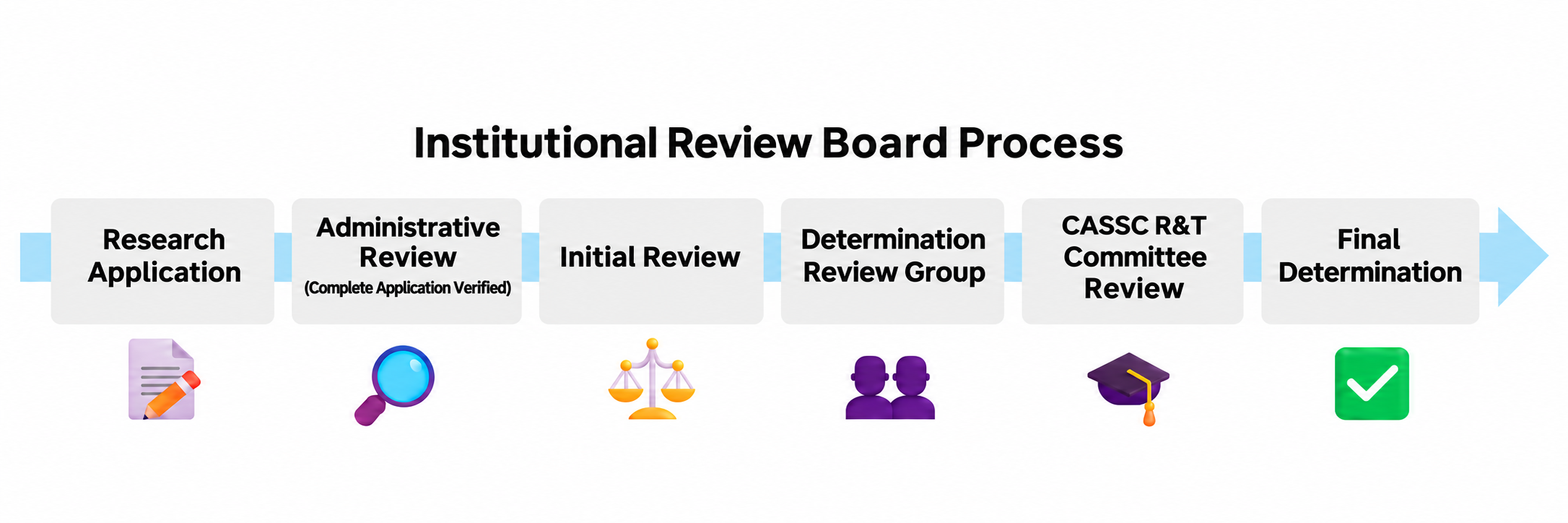
Important:
Submission of an application does not automatically place it into the review process. All submissions undergo an administrative review for completeness. Applications are considered accepted for review only after all required documents and supporting materials have been received and verified. Incomplete applications or applications requiring corrections will be returned to the investigator and will not enter the review timeline until all requirements have been satisfied.
Important Dates
The calendar below lists the Research Application deadlines and the corresponding dates of the CASSC Research & Testing Committee review. To be considered for a given review, please submit your complete application packet by the listed deadline, as the review process begins once an application is complete. See IRB Process section for specific details.
| Research Application Deadline | CASSC Research & Testing Committee Review |
|---|---|
| December 25, 2026 |
January 25, 2027
|
| January 22, 2027 |
February 22, 2027
|
| March 5, 2027 |
April 5, 2027
|
| April 9, 2027 |
May 10, 2027
|
| May 28, 2027 |
June 28, 2027
|
| June 25, 2027 |
July 26, 2027
|
| July 30, 2027 |
August 30, 2027
|
| August 27, 2027 |
September 27, 2027
|
| September 24, 2027 |
October 25, 2027
|
| November 5, 2027 |
December 6, 2027
|
| December 31, 2027 |
January 31, 2028
|
CASSC Research & Testing Committee Review: January 25, 2027
CASSC Research & Testing Committee Review: February 22, 2027
CASSC Research & Testing Committee Review: April 5, 2027
CASSC Research & Testing Committee Review: May 10, 2027
CASSC Research & Testing Committee Review: June 28, 2027
CASSC Research & Testing Committee Review: July 26, 2027
CASSC Research & Testing Committee Review: August 30, 2027
CASSC Research & Testing Committee Review: September 27, 2027
CASSC Research & Testing Committee Review: October 25, 2027
CASSC Research & Testing Committee Review: December 6, 2027
CASSC Research & Testing Committee Review: January 31, 2028
Terms of Data Use
Researchers who use data provided by the Office of Institutional Research agree to the Office of Institutional Effectiveness terms of data use.
IRB Policies and Procedures
The Institutional Review Board Standard Operating Procedure (IRB SOP) outlines the policies and procedures that govern the review of research conducted at Miami Dade College. Researchers should review the SOP before submitting a Research Application to understand the applicable requirements, review pathways, responsibilities, and approval process.
[View the IRB Standard Operating Procedure]
Frequently Asked Questions (FAQs)
The Frequently Asked Questions provide guidance on common topics related to conducting research at Miami Dade College, including application requirements, review timelines, IRB determinations, site authorization, data access, and researcher responsibilities.
Important:
Do not begin recruitment, consent, data collection, analysis of identifiable information, or access to identifiable records until all required approvals have been obtained. Retroactive approval is not available.
The IRB helps protect the rights, welfare, privacy, and safety of individuals who participate in research. It reviews research activities involving human participants before those activities begin and determines the appropriate level of review.
The College Academic and Student Support Council Research & Testing Committee provides institutional review of research proposals after IRB review. The committee considers alignment with the College mission, strategic priorities, institutional values, and operational feasibility.
Research is a systematic investigation, including research development, testing, and evaluation, designed to develop or contribute to generalizable knowledge. Projects meeting this definition and involving human participants may require IRB review.
A human subject is a living individual from whom a researcher obtains information through interaction, intervention, surveys, interviews, observations, or access to identifiable private information for research purposes.
Students, faculty, staff, administrators, and external researchers must submit an application when a project involves human participants, identifiable private information, institutional data, surveys, interviews, focus groups, or other activities that may meet the federal definition of research.
No. Many activities involve people but are not considered research. When there is uncertainty about whether an activity constitutes research, consult the IRB before proceeding.
Not necessarily. A survey used for research may require IRB review. Surveys used for routine operations, customer-service feedback, event evaluation, institutional improvement, or administrative decision-making may not constitute research. The purpose, intended use, and whether the activity is designed to contribute to generalizable knowledge are important factors.
These activities may not be research when their primary purpose is internal operational improvement rather than creating generalizable knowledge. IRB review may be required if the findings will be disseminated as scholarly research or used to answer research questions.
Generally, no, when activities are conducted solely for marketing, public relations, communications, outreach, recruitment, media relations, or promotional purposes and are not designed to contribute to generalizable knowledge. Examples include testimonials, promotional videos, success stories, website features, social-media campaigns, vendor customer-success stories, and institutional marketing materials. Other requirements, including media releases, FERPA compliance, or institutional approvals, may still apply.
Generally, no, when testimonials are collected solely for communications or promotional purposes and are not part of a systematic investigation. Consult the IRB if testimonials will be analyzed or published as research findings or used to study experiences.
No. Publication, presentation, or dissemination alone does not determine whether an activity is research. The purpose of the activity, whether it is a systematic investigation, and whether it is designed to develop or contribute to generalizable knowledge are relevant.
No. Investigators may not make their own exemption determination. The IRB makes the official determination through the review process.
Contact the IRB before beginning the activity. Include a brief description of the project, intended participants, data sources, and the planned use of the information.
The process consists of IRB review and review by the CASSC Research & Testing Committee. Researchers may not begin recruitment, participant contact, access to identifiable information, or data collection until all required approvals have been received.
Complete the online MDC Research Application and submit all required supporting documentation through the Formstack application.
Researchers should generally allow approximately six to eight weeks. Actual timelines may vary based on application completeness, required revisions, and committee schedules.
Submit and obtain approval before beginning recruitment, consent, data collection, analysis of identifiable information, or other research activities involving human participants.
No. Recruitment, consent, participant contact, access to identifiable information, and data collection must not begin until all required approvals have been obtained.
No. Research activities requiring review must be approved before they begin. Retroactive approval is not available.
No. Decisions are final. Investigators may submit a revised or new application for consideration.
Yes, when they involve human participants, private information, surveys, interviews, focus groups, or institutional data and meet the requirements for review.
Yes. The faculty advisor serves as the Principal Investigator and assumes overall responsibility for the project.
Yes, when they involve human subjects research. Approval must be obtained before research activities begin.
Generally, no, when conducted solely for instructional purposes and not intended to contribute to generalizable knowledge. Review may be required when the project meets the definition of human subjects research or will be disseminated beyond the classroom.
Yes. External researchers must complete the MDC research approval process and obtain all required approvals before conducting research involving MDC participants, data, resources, facilities, programs, or personnel.
If the home institution maintains an IRB, include its current approval, exemption, or determination in the MDC research packet.
No. Approval from another institution does not replace MDC review and does not automatically authorize research activities at MDC.
- Not Research or Not Human Subjects Research
- Exempt Research
- Expedited Review
- Full Board Review
Research that meets a federal exemption category may receive an exempt determination. An investigator may not self-determine exemption.
Expedited review applies to eligible categories of minimal-risk research reviewed by designated IRB reviewers rather than the convened board.
Full board review is conducted by the convened IRB for studies involving greater than minimal risk, vulnerable populations, or complex ethical considerations.
Examples include children, prisoners, pregnant women, individuals with diminished decision-making capacity, and economically or educationally disadvantaged persons.
Depending on the study, submit all applicable materials:
- Research protocol or proposal
- Surveys or questionnaires
- Interview and focus-group guides
- Recruitment materials
- Consent, assent, or parental-permission documents
- Training certificates
- Letter of Support
- External approvals
- Data-security information
Incomplete applications are returned for revision and do not enter the review timeline until all required materials are received.
Recruitment materials are communications used to identify, invite, recruit, or inform potential participants, including emails, flyers, announcements, social-media posts, websites, scripts, classroom announcements, and text messages.
Yes. All participant-facing research materials must be submitted and approved before use.
A Letter of Support is required for research applications involving MDC students, faculty, staff, courses, programs, facilities, institutional resources, or institutional data.
A Letter of Support documents institutional awareness and support of the proposed research. It is typically provided by an appropriate dean, director, chair, campus leader, or administrator.
- Missing training documentation
- Missing Letter of Support
- Missing or incomplete consent forms
- Missing research instruments or recruitment materials
- Incomplete application responses
- Insufficient data-security descriptions
Yes. Investigators and research personnel who interact with participants or have access to identifiable private information must complete the required training before submission.
The CITI Human Subjects Research course satisfies the stated MDC training requirement.
Training must be current and completed within the previous three years.
Yes. Research involving protected health information requires Information Privacy and Security training in addition to Human Subjects Research training.
They may be when they are part of a human subjects research study. This includes paper surveys and surveys administered through platforms such as Qualtrics, Formstack, Microsoft Forms, or SurveyMonkey.
The recruitment plan must be described and approved when it involves faculty, staff, student organizations, classes, departments, or other MDC units.
Recruitment may begin only after all required approvals are received and must follow the approved recruitment methods and materials.
Informed consent is a participant's voluntary agreement to participate after receiving sufficient information about the study.
Generally, yes, unless the IRB approves a waiver or alteration of consent requirements.
- Purpose of the study
- Procedures
- Risks and benefits
- Confidentiality protections
- Voluntary participation statement
- Contact information
- Participant rights
Request the waiver or alteration through the MDC Research Application. Only the IRB may approve the request.
Electronic consent may be appropriate when the process adequately informs participants and documents voluntary agreement. The proposed process is subject to IRB review.
Yes. Participants should receive a copy of the signed consent document when signed consent is used.
Yes. Participation is voluntary, and participants may discontinue participation without penalty.
Parental permission is generally required, and child assent may also be required depending on age and ability to understand participation.
No. IRB approval and data-access approval are separate processes. IRB approval does not authorize access to institutional data, protected records, information systems, student records, employee records, or other College resources.
The information helps the IRB evaluate privacy, confidentiality, data security, and human-subject protections. Researchers remain responsible for obtaining separate data-access approvals and permissions.
The Family Educational Rights and Privacy Act is the federal law that protects the privacy of student education records.
Only in circumstances permitted by FERPA and institutional policy, such as certain studies conducted for or on behalf of the College. Otherwise, consent or de-identified data may be required.
De-identified data have identifying information removed so individuals cannot reasonably be identified.
No. De-identification must generally be performed or verified by Institutional Research or another authorized institutional office.
Describe how data will be collected, stored, protected, accessed, retained, and destroyed. Safeguards may include password protection, encryption, restricted access, secure servers, and locked storage.
Depending on the sensitivity of the data, storage on personal devices or unapproved cloud systems may be restricted or prohibited.
Specify the retention period in the research application and follow applicable institutional, sponsor, and regulatory requirements.
IRB review may or may not be required. The determination depends on the activity, the information collected, whether individuals can be identified, and the intended use. Consult the IRB when uncertain.
Submit a Change of Research request and receive approval before implementing changes to recruitment, procedures, participant populations, consent materials, instruments, data collection, or study personnel.
A minor modification does not significantly affect risks, benefits, study aims, or design. Examples include adding study personnel, minor survey revisions, administrative corrections, and recruitment-material updates.
A significant modification materially affects risks, benefits, study design, or participant populations. Examples include adding a vulnerable population, increasing risk, substantially changing the design, or adding sensitive procedures.
Approval may be granted for up to two years, subject to continuing-review requirements.
Researchers submit required information before approval expires. The submission may include study status, enrollment, protocol deviations, modifications, adverse events, and other relevant updates.
Research activities must stop until approval is renewed or extended.
Notify the IRB when data collection and analysis involving identifiable information have concluded.
- Unanticipated problems
- Adverse events
- Protocol deviations
- Unauthorized disclosure of data
- Required study modifications
The project is considered noncompliant, and retroactive approval will not be granted.
Noncompliance may result in suspension or termination of IRB approval and other institutional actions.
Only with prior written authorization from the College President or College Provost. IRB approval alone does not authorize use of the College name.
Contact the MDC IRB
For questions about research applications, review requirements, or IRB procedures, email IRB@mdc.edu. Include a brief description of the project, intended participants, data sources, and planned use of the information.
Open the MDC Research Application
This FAQ is a practical reference. Applicable regulations, College requirements, official procedures, and written IRB determinations govern.
Institutional Review Board Members
The Miami Dade College Institutional Review Board (IRB) is composed of faculty and staff representing a range of professional backgrounds and areas of expertise across the College and the community.
Luisa Canton, IRB Chair
Director of Institutional Research
Silvio Rodriguez, IRB Alternate Chair
Director of Assessment, Evaluation, and Testing
Trinidad Arguelles
Faculty, Social Sciences
Ian Cobham
Faculty, Mathematics
Kimberly Coffman
Faculty, Social Sciences
Jorge (Mike) Cuellar
Dean of Faculty
David Kaiser
Senior Director of Enterprise Data Architect & Analytics
Jennie Ricketts-Duncan
Community member
Isabel Rodriguez-Dehmer
Faculty, English
Pablo Sacasa
Dean, School of Science